

Artificial intelligence is changing how people learn, work, create content, analyse information, and solve everyday problems. From writing assistants to data analysis tools, AI is becoming part of many digital workflows. Developing AI skills can help people understand these technologies, use them responsibly, and make better decisions about when to trust their output.
You do not need to become a machine-learning engineer to get started. Students, freelancers, content creators, employees, and small-business owners can all benefit from understanding what AI can do, where it falls short, and how it fits into their work.
Why Is Learning AI and Technology Important?
The importance of learning AI goes beyond following a technology trend. It is about building the knowledge needed to participate confidently in a world where digital systems influence everyday decisions.
1. Work more effectively: AI can assist with brainstorming, summarising, drafting, organising information, and repetitive tasks. Reviewing its output carefully remains essential.
2. Make informed decisions: Understanding how AI works helps you recognise when an answer needs verification, additional context, or human judgement.
3. Solve practical problems: Basic AI knowledge can help you explore ways to improve research, customer support, content planning, and business processes.
4. Adapt to changing work: Different industries are adopting AI at different rates. Learning the fundamentals gives you a useful starting point for adapting as tools and job requirements evolve.
5. Keep learning independently: Once you understand the basics, you can evaluate new tools more confidently instead of relying only on online trends or promotional claims.
The OECD and European Commission’s AI literacy framework highlights the importance of understanding AI systems, critically evaluating their outputs, and using them ethically and creatively.
AI Skills for the Future: What Should You Develop?
The most useful AI skills for the future combine technical understanding with human judgement. Not every learner needs advanced programming; the right combination depends on personal goals.
1. AI literacy
Understand what AI is, how generative AI differs from other systems, and why its answers can be incorrect. Learn to identify tasks where AI may help and situations that require expert advice or independent verification.
2. Prompting and clear communication
Learn to provide useful context, explain your goal, set constraints, and specify the format you need. Good instructions can improve results, but they cannot guarantee accuracy.
3. Data literacy
Develop the ability to read tables, interpret charts, compare figures, and identify missing or misleading information. AI-generated analysis should always be checked against the original data.
4. Critical thinking and fact-checking
Compare AI answers with reliable sources. Check dates, calculations, quotations, and important claims. Ask whether the evidence actually supports the conclusion.
5. Digital tools and workflow automation
Learn how AI features work within tools for documents, design, spreadsheets, project management, and customer communication. Start with simple workflows before attempting complex automation.
6. Basic technical knowledge
Depending on your goals, explore spreadsheets, data handling, APIs, or introductory Python. These skills are especially useful for people interested in software, analytics, or building AI-powered applications.
7. Privacy and responsible AI use
Avoid entering passwords, confidential business documents, sensitive customer information, or personal data into AI services without appropriate permission and safeguards. Understand copyright, bias, transparency, and the need for human oversight.
The International Labour Organization’s research on AI and skills discusses changing skill needs across digital, cognitive, and socioemotional areas. This reinforces why learning should include both technical ability and human skills.
AI Skills to Learn: A Practical Comparison
| Skill | Practical application | Suitable for |
|---|---|---|
| AI literacy | Understand capabilities and limitations | Everyone |
| Prompt writing | Improve instructions for AI tasks | Students, creators, professionals |
| Data literacy | Interpret reports and check figures | Analysts, accountants, business owners |
| AI-assisted content creation | Develop outlines and draft ideas | Writers, marketers, freelancers |
| AI-assisted design | Explore concepts and speed up design workflows | Designers, creators |
| Workflow automation | Reduce repetitive digital tasks | Teams and small businesses |
| Programming fundamentals | Build or customise technical solutions | Aspiring developers and technical learners |
| Fact-checking and privacy | Review outputs and protect information | Everyone using AI |
This table is a starting point, not a ranking of which skill guarantees the best career outcome. Choose based on the tasks you actually want to perform.
How Students, Freelancers, and Businesses Can Use AI Knowledge
Students: Use AI to clarify difficult concepts, generate practice questions, and organise revision. Verify answers with textbooks, teachers, and trusted learning resources. Do not submit AI-generated work as your own when academic rules prohibit it.
Freelancers and content creators: Explore AI for research planning, content outlines, idea generation, editing, and repetitive administrative work. Add your own expertise, original examples, fact-checking, and client-specific judgement.
Professionals: Learn how AI can support routine tasks such as summarising non-confidential documents, organising information, and preparing first drafts. Follow workplace policies before using AI with company data.
Small-business owners: Consider low-risk uses such as brainstorming campaign ideas, drafting product descriptions, preparing FAQ outlines, or organising customer feedback. Check every claim and protect customer information.
For a foundation, read What Is Artificial Intelligence? A Beginner’s Guide and then explore How AI Is Changing the Way We Work and Learn. These related PUNOVIX articles can help readers build context before moving to more practical applications.
How to Learn AI Skills: A Beginner-Friendly Roadmap
You can begin without buying an expensive course. Follow a structured plan and practise consistently.
Step 1: Learn the fundamentals. Understand AI, machine learning, generative AI, training data, and common limitations. Focus on concepts before memorising technical terms.
Step 2: Pick one real-life goal. For example, a student might practise summarising a lesson; a freelancer might create a content brief; a business owner might draft a customer FAQ.
Step 3: Practise with a tool you can access. Review its privacy settings, free-plan limits, and terms before using it. Start with non-sensitive information.
Step 4: Verify the output. Check facts against reliable sources, test calculations, and revise weak or generic results. Keep track of mistakes so you can improve your instructions.
Step 5: Complete a small project. Build something useful, such as a study guide, a content calendar, a spreadsheet analysis, or a documented workflow. Record what you did and what you checked.
Step 6: Build a learning habit. Review new features and guidance periodically, but prioritise skills you can apply rather than chasing every new tool.
Step 7: Reflect and improve. Ask whether the AI-assisted process saved time, improved quality, or introduced new risks. If it did not help, change the process or use a different approach.
A course certificate can demonstrate learning, but practical projects and the ability to explain your decisions are also valuable.
Challenges and Responsible Use of AI
AI is not a substitute for understanding. It can produce convincing but inaccurate information, reflect biases in data, or misunderstand the context of a request. Some tools also restrict features on free plans, change their terms, or require payment for higher usage.
Before adopting an AI tool, check:
Accuracy: Can you verify important answers independently?
Privacy: What data does the service collect, retain, or use?
Cost: Is the free plan sufficient for your actual needs?
Copyright and permissions: Are you allowed to use the input and output for your intended purpose?
Human oversight: Who is responsible for reviewing the final result?
Use AI as an assistant, not as an unquestioned authority. For high-impact decisions involving health, law, finances, employment, or safety, seek qualified guidance and use appropriate professional processes.
AI Skills for Everyday Work
Developing AI skills can help you evaluate AI-generated information, improve everyday workflows, and use digital tools more responsibly.
Building Practical AI Skills
The best way to develop AI skills is to practise with real tasks, verify the results, and understand the limitations of each tool.
AI Skills and Responsible Learning
Strong AI skills involve more than writing prompts. They also include critical thinking, data literacy, privacy awareness, and fact-checking.
Conclusion
Learning AI and technology is a practical way to become more confident in a changing digital environment. Start with the fundamentals, develop critical thinking and data literacy, practise on real tasks, and verify what AI produces.
The goal is not simply to use more AI. It is to use it thoughtfully, protect information, recognise its limitations, and combine technology with human judgement. Choose one useful project, learn from the results, and build your knowledge step by step.
Start building AI skills step by step by choosing one practical goal, practising regularly, and checking the accuracy of AI-generated results.
Frequently Asked Questions
Q1. Do I need coding skills to start learning AI?
No. Start with AI literacy, clear instructions, critical thinking, and fact-checking. Learn programming later if your goals require technical development or deeper data work.
Q2. What are the best AI skills for beginners?
AI literacy, prompt writing, data literacy, critical thinking, privacy awareness, and responsible use are useful starting points. The best choice depends on your current work and learning goals.
Q3. How long does it take to learn AI skills?
There is no single timeline. Basic familiarity may develop through regular practice, while programming, machine learning, and specialised applications can require substantially more study. Progress depends on your starting point and the time you invest.
Q4. Will learning AI guarantee a job or higher income?
No. Learning AI can strengthen your understanding of modern tools, but employment and income depend on many factors, including experience, communication, domain knowledge, location, and market demand.
Q5. Can I learn AI for free?
You can start with free educational materials and accessible tools, subject to their current availability and limitations. Check official course and product pages for up-to-date access conditions before enrolling or relying on a particular feature.
Related AI & Technology Articles
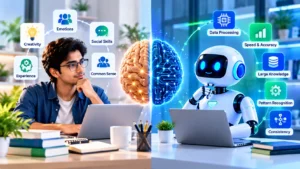
AI vs Human Intelligence: Understanding the Difference
Understand the practical differences between artificial intelligence and human intelligence, including strengths, limits, and collaboration.

AI Tools That Can Improve Your Daily Productivity
Learn practical ways AI tools can help with research, writing, planning, organization, and repetitive digital tasks.

Top AI Skills to Learn for the Future
A practical list of AI-related skills beginners can develop for careers, freelancing, business, and digital work.