
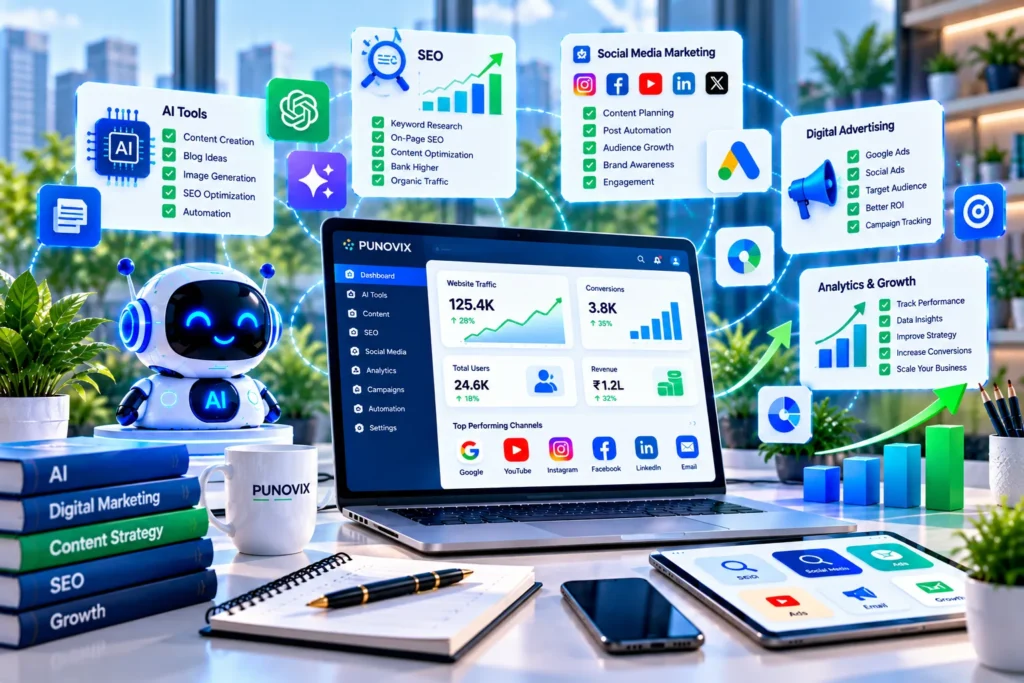
Artificial intelligence is changing how businesses plan campaigns, understand customers, create content, and measure marketing performance. Tasks that once required hours of manual research can now be supported by AI-powered tools. However, using AI effectively involves more than generating text or automating repetitive work. Businesses also need a clear strategy, reliable data, creative thinking, and a proper understanding of their audience.
AI in digital marketing helps marketers analyse information, discover patterns, develop content ideas, personalise communication, and make better-informed decisions. For small businesses, freelancers, agencies, and online entrepreneurs, these capabilities can make marketing workflows more organised and efficient.
The key is to use AI as a practical assistant rather than a replacement for human judgement. In this guide, you will learn how AI works in digital marketing, where it can be useful, which benefits and limitations to consider, and how to introduce it into your marketing workflow.
What Is AI in Digital Marketing?
AI in digital marketing refers to using artificial intelligence technologies to support activities such as content planning, search engine optimisation (SEO), audience analysis, email marketing, advertising, social media management, and campaign reporting.
Depending on the tool, AI may analyse large amounts of information, identify patterns, generate suggestions, classify customer feedback, or help automate specific tasks. Some systems use predictive AI to estimate likely outcomes, while generative AI creates new material such as text, images, and campaign ideas.
For example, a business selling products online might use AI to organise customer questions, identify popular product categories, suggest email topics, and summarise campaign results. A freelancer might use it to prepare a content calendar or create an initial outline for a client proposal.
AI does not automatically make a marketing campaign successful. Results still depend on the quality of the data, the relevance of the message, the needs of the audience, and the decisions made by the marketing team.
7 Practical Ways to Use AI in Digital Marketing
1. Content Research and Planning
Content marketing requires regular research, planning, writing, editing, and publishing. AI can help organise these activities by suggesting topic ideas, creating outlines, grouping related questions, and turning a broad subject into a manageable content plan.
For example, a digital marketing freelancer could use an AI assistant to brainstorm blog topics for a local business. The freelancer could then evaluate those ideas using keyword research, competitor analysis, customer questions, and the business’s goals.
AI can also help adapt a central idea into different formats, such as a blog outline, a social media caption, an email newsletter, or a short video script. Each version should still be edited for its platform and audience.
Best practice: Treat AI-generated content as a starting point. Add original insights, accurate information, relevant examples, and a clear human perspective before publishing.
2. Search Engine Optimisation (SEO)
SEO involves understanding what people search for, creating useful pages, improving website structure, and helping search engines understand the content. AI can support several parts of this process.
It can help organise keyword ideas by search intent, suggest related questions, create initial content outlines, and identify possible gaps in an article. It may also help summarise website performance data when the information is supplied to the tool.
For example, a website owner preparing an article about online business tools could group search queries into informational, comparison, and purchase-related topics. The owner could then create sections that answer the most relevant questions.
However, AI suggestions do not replace keyword research or technical SEO checks. Search volume, keyword difficulty, competition, and search intent should be checked using appropriate tools and actual search results.
For a practical starting point, read What Is Artificial Intelligence? A Beginner’s Guide to understand the technology behind these applications.
Remember that useful content should solve a reader’s problem. Repeating keywords or publishing large amounts of generic AI-generated text does not guarantee better rankings. Google’s guidance emphasises helpful, reliable, people-first content and the importance of adding genuine value.
3. Social Media Content and Scheduling
Social media marketing requires consistent publishing and communication. AI can help generate post ideas, organise weekly content themes, draft captions, and adapt messages for different platforms.
A small business might plan a week of posts around product education, customer questions, behind-the-scenes updates, and service benefits. An AI assistant can suggest an initial calendar, while the business owner checks that the ideas match the brand’s voice and actual offerings.
AI can also help repurpose a long article into several shorter posts. However, each post should be reviewed for accuracy, readability, platform requirements, and audience expectations.
Automation should not remove the human side of social media. Customer replies, complaints, sensitive questions, and public statements may need direct human attention.
Practical tip: Create a repeatable workflow: research the topic, prepare a draft, check facts, adapt the content to the platform, approve it, and then schedule or publish it.
4. Email Marketing and Personalisation
Email marketing can be more relevant when messages reflect customers’ interests and preferences. AI can assist with subject-line ideas, draft variations, email summaries, and audience segmentation.
For example, an online store could separate customers who have purchased a product from those who have only subscribed to its newsletter. The store could then prepare different messages for each group, provided the segmentation is appropriate and the data is used responsibly.
AI can also help marketers test different subject lines or calls to action. Actual performance should be evaluated using meaningful metrics such as clicks, conversions, unsubscribes, and revenue where applicable.
Personalisation should never mean making unsupported assumptions about a customer. Businesses must respect consent, privacy obligations, and communication preferences.
5. Audience Insights and Campaign Analysis
Digital campaigns generate data from sources such as website analytics, advertising platforms, email systems, and customer feedback. AI can help summarise this information and highlight patterns that deserve further investigation.
For example, a marketer could provide an approved, non-sensitive campaign report and ask an AI tool to compare traffic, engagement, and conversion trends. The tool might identify that one landing page attracts visitors but receives relatively few enquiries.
That observation is a starting point for investigation, not proof of the cause. The marketer should review tracking quality, page content, audience relevance, loading performance, and the customer journey before making changes.
Good analysis connects metrics with business objectives. More impressions or clicks are not necessarily better if they do not contribute to meaningful outcomes.
6. Creative Ideas and Campaign Development
Creative work often begins with research and experimentation. AI can support brainstorming by suggesting campaign themes, headline alternatives, visual concepts, and different ways to explain a product or service.
For example, a freelancer designing a campaign for a local business might explore educational, problem-solving, and seasonal creative directions before selecting the most suitable concept.
AI-generated suggestions should be checked for originality, factual accuracy, brand consistency, and appropriate use rights. Businesses should also review the terms of the tools they use and avoid submitting confidential client information without permission.
Human creativity remains essential because a campaign needs a clear point of view, cultural understanding, emotional relevance, and a reason for customers to care.
7. Workflow Automation and Productivity
Some marketing activities are repetitive, including organising content ideas, preparing routine reports, categorising feedback, and moving approved information between systems. AI-enabled workflows can help reduce manual effort when tasks and permissions are clearly defined.
For example, a content workflow might collect topic ideas, place approved topics in a planning sheet, generate an initial outline, and notify an editor when a draft is ready for review.
Automation should include safeguards. A generated draft should not automatically become a published article without editorial checks. Similarly, advertising budgets, customer messages, and important business decisions should have suitable approval processes.
To understand how these changes affect everyday work, explore How AI Is Changing the Way We Work and Learn.
Benefits of AI in Digital Marketing
The benefits of AI in digital marketing depend on how the technology is used, the quality of the available information, and the business’s objectives.
Better organisation and time management
AI can help prepare first drafts, organise research, summarise reports, and create structured plans. This can leave marketers with more time for strategy, customer relationships, and creative decisions.
Faster access to insights
AI tools can help organise large amounts of information and highlight possible patterns. Marketers can use these observations to decide what to investigate next instead of reviewing every item manually.
More relevant communication
When used with appropriate data and clear customer preferences, AI can help businesses prepare content for different audience segments. Personalisation should remain respectful, accurate, and useful.
Support for small businesses
Small teams often have limited time and resources. AI can provide assistance with brainstorming, planning, drafting, and reporting without requiring every task to begin from scratch.
More consistent workflows
Templates, structured prompts, and review checklists can help teams follow a repeatable process. Consistency is particularly valuable when several people contribute to a campaign.
These benefits are not guaranteed outcomes. Businesses should test changes on a manageable scale and compare the results against a relevant baseline.
Challenges and Limitations of AI Marketing
AI is useful, but it has limitations that marketers should understand before relying on it.
Inaccurate information
AI systems can produce confident-sounding but incorrect statements. Verify facts, statistics, product specifications, legal claims, and important recommendations before using them.
Generic content
A draft may sound polished while offering little original value. Improve it with real customer questions, relevant examples, first-hand experience, and information specific to the business.
Privacy and data protection
Do not enter confidential client records, personal customer details, passwords, or sensitive business information into a tool unless its approved use, security arrangements, and relevant permissions have been checked.
Bias and poor assumptions
AI outputs may reflect limitations in the data or prompt. Review recommendations for fairness, relevance, and unintended effects, especially when they influence customer targeting or important decisions.
Overdependence on automation
Automating every activity can make a brand sound impersonal and may allow errors to spread quickly. Keep human review in workflows where accuracy, reputation, spending, or customer trust is at stake.
Google’s published guidance explains that using AI to assist with content is not automatically a problem; the emphasis is on quality, accuracy, originality, and value for people. Read Google Search’s guidance on generative AI content before building an AI-assisted publishing process.
How to Start Using AI in Digital Marketing
You do not need to automate an entire marketing operation at once. Start with one clearly defined problem and expand only when the workflow proves useful.
Step 1: Choose one specific task
Identify a repetitive activity, such as brainstorming blog topics, preparing social captions, or summarising a campaign report. A narrow task is easier to evaluate than a broad goal such as “automate all marketing.”
Step 2: Define the expected result
Decide what success means. It might be a more organised content calendar, fewer editing rounds, faster report preparation, or better-quality campaign insights. Avoid assuming that time saved automatically means improved business performance.
Step 3: Select a suitable tool
Compare tools based on the task, available features, cost, privacy, integrations, and ease of use. A general AI assistant may be sufficient for drafting, while analytics or advertising tasks may require platform-specific tools.
Step 4: Provide clear instructions
Explain the target audience, purpose, brand tone, format, restrictions, and expected output. Include reliable source material when needed. Clear instructions usually produce more useful starting drafts than vague requests.
Step 5: Review the output
Check facts, grammar, tone, originality, links, and suitability for the audience. For SEO articles, verify the search intent, keyword placement, internal links, and page structure before publication.
Step 6: Measure performance
Compare the results with your starting point. Use relevant measures such as time spent, engagement, qualified leads, conversions, or cost per result. A small test can reveal whether the workflow is worth keeping.
Step 7: Improve gradually
Keep a record of what worked, what required correction, and which instructions produced better results. Update your process as the business, tools, and customer needs change.
If you are building your foundation in this area, Top AI Skills to Learn for the Future can help you explore the broader skills associated with AI and technology.
How to Choose AI Tools for Digital Marketing
The best tool depends on the problem you need to solve. Avoid selecting a product simply because it is popular or advertises many features.
Before adopting AI tools used in digital marketing, consider these questions:
Purpose: Does the tool solve a real problem in your workflow?
Accuracy: Can you review its outputs and verify important information?
Privacy: Are the data handling terms and permissions appropriate?
Integration: Does it work with your existing systems?
Cost: Is the value justified by the subscription or usage cost?
Control: Can a person review and approve important actions?
Measurement: Can you evaluate whether the tool improves results?
Start with a small trial where possible. Record the time, effort, and quality of the result before deciding whether to expand its use.
The Future of AI in Digital Marketing
The future of AI in digital marketing will likely involve more integration between content workflows, analytics, customer communication, and advertising systems. Tools may continue to improve at assisting with research, identifying patterns, and adapting work to specific objectives.
However, technology alone will not create a strong marketing strategy. Businesses will still need to understand customer needs, communicate honestly, protect personal information, and distinguish useful insights from unreliable recommendations.
Marketers who combine technical awareness with writing, research, analytics, creativity, and critical thinking will be better prepared to evaluate new tools. They should also remain willing to test claims rather than assume that every new feature will improve results.
For small businesses and freelancers, a sensible approach is to learn the fundamentals, choose a practical use case, measure the outcome, and expand only when there is evidence of value.
Conclusion
AI is becoming a practical part of digital marketing, supporting content research, SEO, social media planning, email communication, campaign analysis, creative development, and automation. Its greatest value comes from solving specific problems and helping marketers make better-informed decisions.
The most effective approach is not to automate everything. Instead, combine AI assistance with reliable research, human creativity, responsible data use, and regular performance checks. This allows businesses to experiment with new capabilities while protecting quality and customer trust.
For PUNOVIX readers, the next step is simple: choose one marketing activity, test an AI-assisted workflow, and evaluate the result before expanding it. Technology can support the work, but a clear strategy and useful content remain essential.
Frequently Asked Questions
Q1. What is AI in digital marketing?
AI in digital marketing means using artificial intelligence to support tasks such as content planning, SEO research, campaign analysis, audience segmentation, email marketing, and workflow automation.
Q2. How can beginners use AI in digital marketing?
Beginners can start with simple tasks such as brainstorming content ideas, creating an initial social media calendar, outlining a blog post, or summarising a non-sensitive report. They should review the results and learn the basics of marketing alongside the tools.
Q3. What are the main benefits of AI in digital marketing?
Potential benefits include better organisation, faster drafting, assistance with data analysis, more structured workflows, and support for audience-specific communication. Actual results depend on implementation and should be measured.
Q4. Can AI replace digital marketers?
AI can assist with selected tasks, but it does not remove the need for strategy, creative judgement, customer understanding, fact-checking, ethical decisions, and accountability. Human oversight remains important.
Q5. Can AI-generated content rank on Google?
AI-assisted content can appear in Search when it meets Google’s applicable requirements. Using AI does not guarantee rankings. Content should be accurate, helpful, original, and created to serve people rather than manipulate search results.
Q6. How should a small business get started?
Choose one repetitive marketing task, test a suitable tool, review every important output, and measure the result. Expand the workflow only when it provides clear value.
Related AI & Technology Articles

AI vs Human Intelligence: Understanding the Difference
Understand the practical differences between artificial intelligence and human intelligence, including strengths, limits, and collaboration.

AI Tools That Can Improve Your Daily Productivity
Learn practical ways AI tools can help with research, writing, planning, organization, and repetitive digital tasks.

Top AI Skills to Learn for the Future
A practical list of AI-related skills beginners can develop for careers, freelancing, business, and digital work.