
PUNOVIX Blog

Artificial intelligence is becoming part of education, business, research, and everyday professional life. As organisations adopt AI-powered systems, people need practical skills to understand the technology, evaluate its output, and use it responsibly. This makes artificial intelligence skills to learn an important topic for students, freelancers, entrepreneurs, and working professionals.
The good news is that learning AI does not always require a computer science degree. Many useful skills involve clear communication, analytical thinking, problem-solving, creativity, and responsible decision-making. Technical skills such as programming and machine learning can be added later, depending on your career goals.
In this guide, you will discover seven AI skills for the future, how to develop them as a beginner, and which skills may be most useful for your professional journey.
The most valuable artificial intelligence skills to learn combine practical AI knowledge with critical thinking, problem-solving, and responsible decision-making.
Why Are AI Skills Important for the Future?
AI is changing how organisations analyse information, develop products, conduct research, and manage routine tasks. However, using AI effectively requires more than knowing which tool to open. People must understand its limitations, check the information it provides, and decide when human judgement is necessary.
The World Economic Forum’s Future of Jobs Report 2025 identifies AI and big data among the technology skills expected to grow in importance. It also highlights human capabilities such as analytical thinking, creative thinking, resilience, and adaptability.
For learners, this means combining technology knowledge with skills that remain valuable across different industries. For example, a student can use AI to support research, a freelancer can improve a project workflow, and a small business owner can analyse customer feedback more efficiently.
Before developing these abilities, it helps to understand what artificial intelligence is and how AI systems are used in everyday life.
The most useful artificial intelligence skills to learn are therefore transferable. They help people adapt as technology changes instead of depending on one particular platform.
The World Economic Forum’s Future of Jobs Report 2025 highlights the growing importance of AI and big data skills, alongside analytical thinking and adaptability.
Developing AI skills for the future can help students, freelancers, and business owners adapt to changing workplace requirements and use AI more effectively.
7 Artificial Intelligence Skills to Learn for the Future
1. AI Literacy and Understanding AI Systems
AI literacy is the ability to understand what AI systems can do, how their outputs should be interpreted, and where their limitations may appear. It is one of the best AI skills to learn for the future because it provides a foundation for other AI-related abilities.
Start by understanding basic concepts such as machine learning, generative AI, training data, and AI-generated content. You do not need to master the mathematics behind every model before learning how to use AI responsibly.
For example, an AI system may generate a convincing answer that contains an incorrect fact. Recognising this possibility helps you approach the result critically rather than accepting it automatically.
How to practise: Choose a simple topic, ask an AI system to explain it, and verify the important claims using reliable sources. Note what the system explains well and where its answer needs correction.
2. Prompt Writing and Clear Communication
Prompt writing means giving an AI system clear instructions, relevant context, and a defined goal. Better instructions can make the results more useful and reduce unnecessary revisions.
A vague request such as “write about marketing” leaves many decisions open. A more useful prompt specifies the audience, purpose, tone, format, and information required.
For example, a freelancer might ask for a client proposal outline for a small Indian business, including project scope, deliverables, timeline, and questions that need clarification. The freelancer should then review and customise the draft.
Prompt writing is not simply about memorising special commands. It is about explaining what you need, assessing the response, and refining your instructions when necessary.
How to practise: Take one everyday task and write two prompts: a basic version and a more detailed version. Compare the results and identify which instructions improved the output.
3. Data Literacy and Analytical Thinking
Data literacy is the ability to read, organise, interpret, and question information. AI can help summarise large amounts of data, but users still need to understand what the numbers mean.
These skills are useful in accounting, marketing, education, sales, research, and business management. For example, a small business owner may compare monthly sales, customer enquiries, or expenses to identify patterns and ask better questions.
Start with spreadsheets, percentages, averages, charts, and basic data cleaning. Learn to distinguish a genuine pattern from an assumption. When using AI to analyse data, check calculations and confirm that the source information is accurate.
How to practise: Use a sample spreadsheet of monthly expenses. Calculate totals, identify the largest expense categories, and write three observations. Then compare your findings with an AI-generated summary.
This combination of data literacy and AI assistance is more useful than relying on automated conclusions without understanding them.
4. Problem-Solving and Workflow Thinking
One of the most practical new AI skills to learn is the ability to break a complex task into smaller, manageable steps.
Before applying AI, identify the problem, the desired outcome, the information available, and the parts that require human approval. This helps you decide where AI could assist and where manual work remains necessary.
Consider a freelancer preparing a project proposal. The workflow may include collecting the client’s requirements, defining deliverables, estimating time, preparing a draft, checking the details, and sending the final proposal. AI may support selected steps, but the freelancer remains responsible for pricing, commitments, and accuracy.
You do not need advanced programming knowledge to begin thinking in workflows. Start by mapping a repetitive process and identifying its bottlenecks.
How to practise: Write down the steps involved in completing one recurring task. Mark which steps involve research, writing, calculations, decisions, or approvals. Identify one step where AI assistance could save time without reducing quality.
5. Critical Thinking and Verification
AI-generated content can sound confident even when it is incomplete, outdated, or inaccurate. Critical thinking helps you evaluate whether an answer is supported by evidence and suitable for the situation.
This skill is particularly important when working with statistics, financial information, technical instructions, research, or claims about current events.
When reviewing an AI response, ask:
Is the information supported by trustworthy evidence?
Does the source actually support the claim?
Are important details missing?
Could the answer contain bias or an incorrect assumption?
Does the conclusion follow from the available information?
For example, if an AI-generated article includes a market statistic, locate the original report and confirm the date, context, and meaning before publishing it.
How to practise: Select one factual answer from an AI system and verify three important claims against reliable sources. Correct any unsupported statements before using the material.
Critical thinking is among the most valuable artificial intelligence skills to learn because it keeps people involved in the decision-making process.
6. AI Ethics, Privacy, and Responsible Use
Using AI responsibly involves protecting personal information, respecting intellectual property, understanding potential bias, and following applicable laws and workplace policies.
Never assume that confidential client records, financial details, passwords, private documents, or sensitive personal information are safe to upload to every AI platform. Review the service’s privacy settings and terms before sharing information.
Responsible use also means disclosing AI assistance when required, checking permissions for images and other creative assets, and ensuring that AI-supported decisions receive appropriate human review.
UNESCO’s AI competency framework for students emphasises human-centred thinking, AI ethics, AI techniques and applications, and AI system design. These principles provide a useful foundation for learning about AI beyond simply operating a tool.
How to practise: Create a personal AI-use checklist. Include privacy, source verification, permission to use content, bias checks, and situations where a human expert must make the final decision.
UNESCO’s AI competency framework for students provides guidance on human-centred thinking, AI ethics, and responsible AI learning.
7. Creativity, Communication, and Lifelong Learning
AI can help people explore ideas, organise information, and develop initial drafts. However, strong communication and creative judgement are still essential for deciding which ideas are relevant, original, and appropriate for a particular audience.
A graphic designer, for example, needs to understand the client’s brand, audience, visual hierarchy, and message. AI may support the creative process, but the designer must evaluate the results and make informed design decisions.
Similarly, professionals need to explain findings clearly, listen to feedback, collaborate with others, and adapt their work as requirements change.
Technology also evolves quickly. A tool or workflow that is useful today may change tomorrow, so continuous learning is more valuable than memorising one platform’s features.
How to practise: Complete a small project every month. Document the problem, your approach, what you learned, and how you improved the final result. This creates evidence of your abilities that you can share in a portfolio.
How to Develop AI Skills as a Beginner
To see how these changes affect everyday tasks, read our guide on how AI is changing the way we work and learn.
You do not need to learn everything at once. A simple learning plan can help you build confidence and apply each skill to a real task.
Step 1: Set a clear goal. Decide whether you want to improve your studies, freelance services, business processes, or technical knowledge.
Step 2: Build AI literacy. Learn the basic concepts, common uses, limitations, and responsible-use principles before depending on AI for important work.
Step 3: Practise clear prompting. Give specific instructions, review the responses, and refine your prompts according to the result you need.
Step 4: Strengthen analytical thinking. Practise spreadsheets, research, evidence checking, and structured problem-solving alongside AI use.
Step 5: Complete a practical project. Create a research summary, a sample report, a content outline, or a documented workflow. Check the output before including it in your portfolio.
Step 6: Review and improve. Record what worked, what failed, and what you need to learn next. Seek feedback and repeat the process with a slightly more challenging task.
This approach answers the practical question of how to develop AI skills without requiring an expensive course at the beginning. Free learning resources, practice projects, and reliable documentation can provide a useful starting point.
If you are exploring how to develop AI skills, start with simple projects, practise clear prompts, verify AI-generated information, and gradually build your confidence.
Which AI Skills Should You Learn First?
The best starting point depends on your current responsibilities and long-term goals.
Students: Begin with AI literacy, research verification, prompt writing, and responsible academic use.
Freelancers and creators: Focus on clear communication, critical review, creativity, client confidentiality, and workflow planning.
Business owners: Develop data literacy, problem-solving, process analysis, and responsible decision-making.
Technical professionals: Build on the fundamentals with programming, statistics, data analysis, machine learning, and model evaluation where relevant.
These are practical starting points, not rigid rules. You can combine several paths as your experience grows. The aim is to develop skills that solve real problems rather than collecting certificates without applying what you learn.
The best AI skills to learn for the future depend on your career goals, current abilities, and the problems you want to solve.
Conclusion
The most valuable artificial intelligence skills to learn are not limited to technical expertise. AI literacy, clear communication, data analysis, problem-solving, critical thinking, responsible use, and creativity can help people adapt to changing professional needs.
Choose one skill, practise it through a real project, verify your results, and gradually expand your knowledge. By combining AI capabilities with human judgement and continuous learning, you can build a stronger foundation for the future.
Exploring new AI skills to learn through practical projects and continuous learning can help you prepare for emerging opportunities without depending on a single AI tool.
Explore more practical guides on PUNOVIX to continue developing your digital and professional skills.
Frequently Asked Questions
Q1. What are the most important AI skills to learn for the future?
Useful skills include AI literacy, clear prompt writing, data literacy, analytical thinking, problem-solving, critical thinking, responsible AI use, creativity, and lifelong learning. The best combination depends on your goals and current experience.
Q2. Can I learn AI skills without programming?
Yes. Many foundational skills do not require programming, including AI literacy, prompt writing, output verification, responsible use, and workflow thinking. Programming becomes more important for people pursuing technical development or specialised AI roles.
Q3. How do I develop AI skills as a beginner?
Start with the fundamentals, choose a real task, practise giving clear instructions, verify results, and document what you learn. Build gradually instead of attempting to learn every AI topic at once.
Q4. Are AI skills useful for students and freelancers?
They can be useful when they help people learn, solve problems, organise information, and evaluate results. Their value depends on the quality of the work and the ability to apply skills responsibly.
Q5. Do I need to learn every new AI technology?
No. Technologies change, so it is more practical to build transferable foundations such as critical thinking, data literacy, clear communication, and responsible use. You can then learn specialised knowledge when it becomes relevant to your goals.
Related AI & Technology Articles
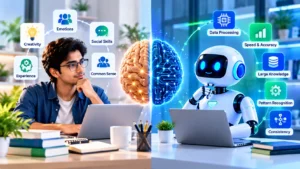
AI vs Human Intelligence: Understanding the Difference
Understand the practical differences between artificial intelligence and human intelligence, including strengths, limits, and collaboration.

AI Tools That Can Improve Your Daily Productivity
Learn practical ways AI tools can help with research, writing, planning, organization, and repetitive digital tasks.

Top AI Skills to Learn for the Future
A practical list of AI-related skills beginners can develop for careers, freelancing, business, and digital work.