
PUNOVIX Blog
What Is Artificial Intelligence?
What Is Artificial Intelligence? (AI) is a technology that helps computers perform tasks that usually require human intelligence. From the videos recommended by YouTube to chatbots that answer our questions, AI is already part of everyday life.
For another beginner-friendly explanation, read Google Cloud’s guide to artificial intelligence.
Artificial intelligence can help systems recognise patterns, analyse information, understand language, make predictions, and generate content. However, AI does not think or understand the world exactly as humans do. Its capabilities depend on how the system is designed, trained, and used.
In this beginner-friendly guide, you will learn how AI works, how it differs from machine learning and generative AI, where it is used, its benefits and limitations, and how beginners can start learning about it.
How Does Artificial Intelligence Work?
AI systems use data, algorithms, and computing power to perform specific tasks. Many modern AI systems are trained on examples so that they can identify patterns and use those patterns to make predictions or generate responses.
For example, an image-recognition system can be trained using many labelled pictures of cats and dogs. After training, it may be able to identify whether a new picture contains a cat or a dog. Its accuracy depends on the quality of the training data and how well the system handles new examples.
Generative AI works differently from a system that only classifies information. It learns patterns from training data and uses them to generate outputs such as text, images, audio, video, or computer code in response to a prompt.
AI results are not always correct. A system may misunderstand a question, miss important context, or produce information that sounds convincing but is inaccurate. Important answers should be checked before you rely on them.
AI vs Machine Learning vs Deep Learning vs Generative AI
These terms are closely related, but they describe different concepts.
Artificial Intelligence (AI): The broad field of developing computer systems that perform tasks associated with human intelligence, such as language processing, pattern recognition, and problem-solving.
Machine Learning (ML): A branch of AI in which systems learn patterns from data to make predictions or decisions without requiring a separate rule for every possible situation.
To explore machine learning in more detail, see Google Cloud’s introduction to machine learning.
Deep Learning: A type of machine learning that uses neural networks with multiple layers to learn complex patterns in data, including images, speech, and language.
Generative AI: AI designed to create new content, such as written responses, images, audio, video, and code, based on learned patterns and user instructions.
Think of AI as the broad category, machine learning as one approach within AI, and deep learning as a specialised approach within machine learning. Generative AI describes systems designed to produce content; many modern generative AI systems use deep learning.
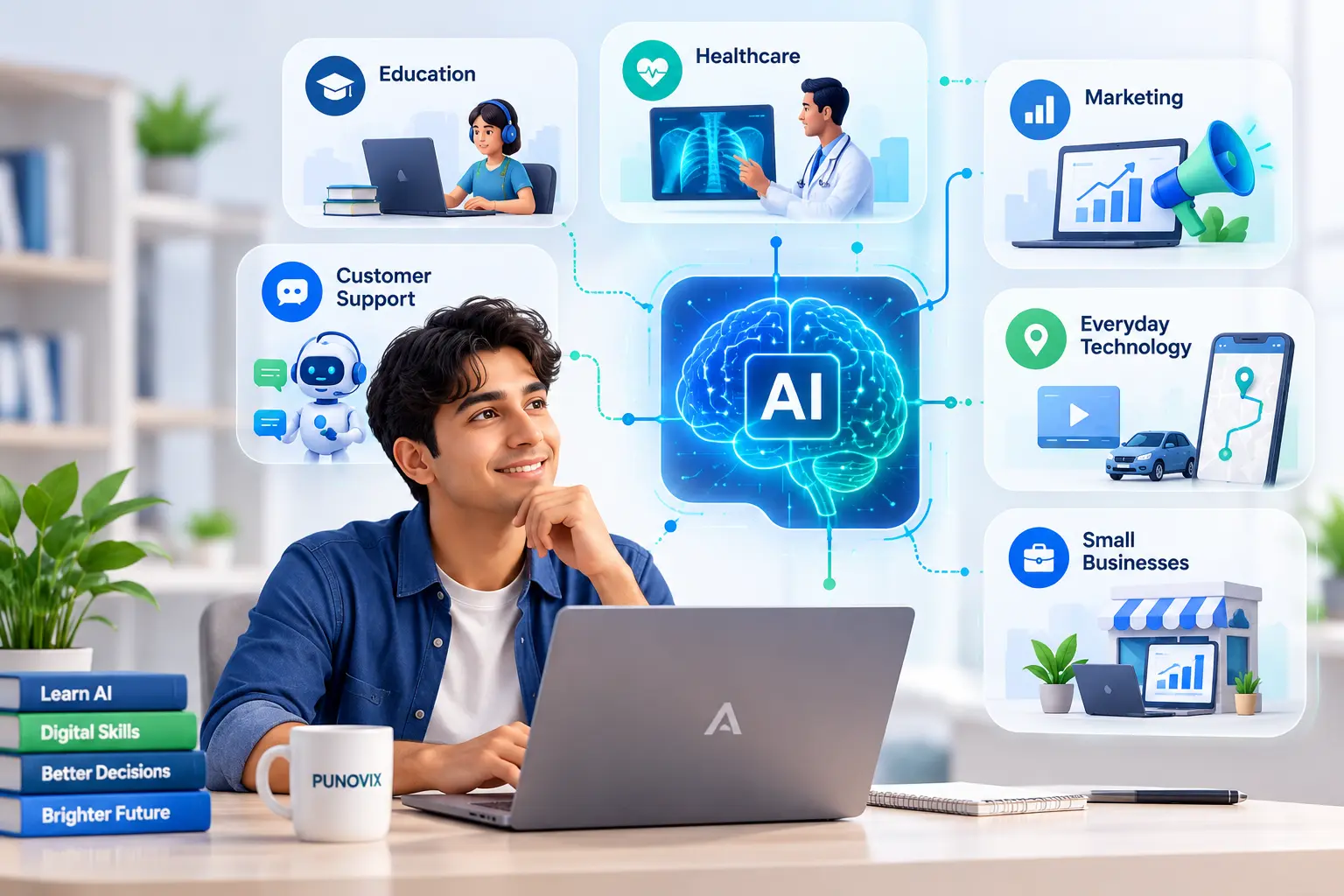
Where Is Artificial Intelligence Used in Everyday Life?
Artificial intelligence is used in many everyday services and professional settings. Common examples include:
Education and Learning
AI tools can explain concepts, create practice questions, summarise study material, and help learners explore difficult topics. Students should still verify facts and use these tools to support learning rather than simply copying answers.
Healthcare
AI systems can help qualified professionals analyse medical images, organise information, and identify patterns that may need further investigation. They support professional judgement; they do not replace medical expertise.
Marketing and Content Creation
Businesses may use AI to brainstorm campaign ideas, organise customer feedback, draft content, and analyse marketing data. Human review remains important to ensure that content is accurate, relevant, original, and appropriate for its audience.
Customer Support
Chatbots can answer common questions, guide customers through basic processes, and help support teams manage routine requests. Complex or sensitive issues may still require a human representative.
Everyday Technology
AI may help power personalised video and product recommendations, spam filtering, speech recognition, translation, and navigation features. The exact technology used varies from one service to another.
Small Businesses and Freelancers
Small businesses and freelancers can explore AI for research, planning, summarising documents, drafting emails, organising information, and developing initial content ideas. Always check the output before sharing it with customers or using it to make business decisions.
Benefits of Artificial Intelligence for Beginners and Businesses
For example, AI can help people save time, analyse information, support learning, improve accessibility, encourage creativity, and explore options for decision-making.
Save time: Assist with repetitive tasks, first drafts, and information organisation.
Analyse information: Identify patterns in large datasets and help people explore possible insights.
Support learning: Explain topics in different ways and generate practice exercises.
Improve accessibility: Help with transcription, translation, speech recognition, and other assistive tasks.
Support creativity: Generate starting points for writing, design concepts, and brainstorming.
Assist decision-making: Provide summaries and possible options for people to review.
These benefits depend on the task, the tool, the quality of the available information, and appropriate human oversight. AI should not be assumed to improve every task automatically.
Limitations and Risks of AI
However, AI has limitations that users should understand before relying on its output.
Incorrect information: AI can generate inaccurate answers or references.
Bias: Results can reflect problems or gaps in training data and system design.
Privacy concerns: Entering confidential business, financial, or personal information into an AI service may create risks.
Limited context: A system may miss important details or misunderstand what a person really needs.
Lack of human judgement: AI cannot be assumed to understand emotions, responsibility, or real-world consequences as a person does.
Over-reliance: Accepting every output without checking it can lead to avoidable mistakes.
To use AI responsibly, verify important facts, avoid sharing sensitive information unless you understand the service’s privacy terms, review generated content, and use human judgement for consequential decisions.
How Can Beginners Start Learning AI?
You do not need to become a programmer before you can begin learning about artificial intelligence. Start with the basics and build your understanding gradually.
Learn the basic terms. Understand AI, machine learning, deep learning, and generative AI.
Try a simple AI tool. Use it for a low-risk task, such as brainstorming ideas, summarising non-confidential text, or creating a study plan.
Practise writing clear prompts. Explain your goal, provide relevant context, and specify the format you need.
Check the results. Compare important claims with reliable sources and correct mistakes before using the output.
Apply AI to a real task. Try organising research, preparing a first draft, or planning a project while keeping human review in the process.
Keep learning responsibly. Explore beginner courses and documentation from established educational or technology organisations.
If you later want to build AI applications or pursue a technical career, you can progress to programming, statistics, data analysis, and machine learning fundamentals. Choose the next step according to your goals rather than trying to learn everything at once.
Conclusion
Artificial intelligence is a broad field of technology that helps computers perform tasks such as recognising patterns, processing language, making predictions, and generating content. It is already used in education, healthcare, marketing, customer support, and everyday digital services.
For beginners, the best starting point is to understand the basic concepts, practise with simple tasks, and check AI-generated results carefully. Used thoughtfully, AI can support learning and productivity, but it should complement human judgement rather than replace it.
Continue exploring PUNOVIX’s AI and Technology guides to learn about practical AI tools and digital skills.
Frequently Asked Questions
Q1. What is artificial intelligence in simple words?
Artificial intelligence (AI) is technology that helps computers perform tasks such as recognising patterns, processing language, making predictions, and generating responses.
Q2. How does artificial intelligence work?
AI systems use data, algorithms, and computing power to identify patterns and perform tasks. Depending on the system, they may make predictions, classify information, or generate content.
Q3. Where is AI used in everyday life?
AI is used in services such as video recommendations, spam filters, navigation, translation, online shopping, education tools, and customer support chatbots.
Q4. Can beginners learn AI without coding?
Yes. Beginners can learn AI concepts and use many AI tools without coding. Programming becomes useful for people who want to build AI applications or pursue more technical roles.
Q5. What are the limitations of AI?
AI can produce inaccurate information, reflect bias, misunderstand context, and raise privacy concerns. Check important information, protect sensitive data, and use human judgement for consequential decisions.
Related AI & Technology Articles
AI vs Human Intelligence: Understanding the Difference
Understand the practical differences between artificial intelligence and human intelligence, including strengths, limits, and collaboration.

AI Tools That Can Improve Your Daily Productivity
Learn practical ways AI tools can help with research, writing, planning, organization, and repetitive digital tasks.

Top AI Skills to Learn for the Future
A practical list of AI-related skills beginners can develop for careers, freelancing, business, and digital work.