
PUNOVIX Blog
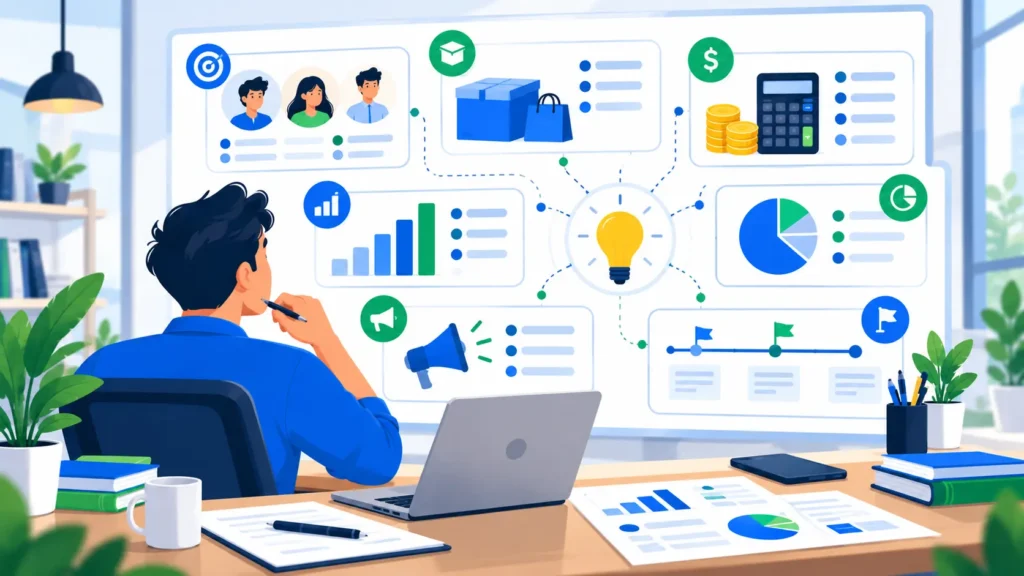
A business plan helps turn a business idea into a practical set of decisions. It explains what you want to sell, who your customers are, how you will reach them, what it will cost to operate, and how you will judge progress. You do not need a large company or a complicated document to benefit from planning. A freelancer, home-based business owner, online seller, or local service provider can start with a clear, useful plan and update it as the business learns.
This guide explains what to include, how to build a financial estimate, and how to use a business plan for small business template without filling it with vague promises. A business plan for small business template is most useful when its sections lead to practical decisions you can review and act on. You will also see an illustrative business plan example for small business and a compact one-page format you can adapt. The figures in the example are hypothetical planning numbers, not forecasts or promises of income.
A good plan is not a guarantee of success. It is a tool for asking better questions, spotting gaps before spending money, communicating with partners or lenders, and keeping decisions connected to your goals.
What Is a Business Plan?
A business plan is a written description of how a business intends to operate and develop. It usually covers the problem being solved, the target customers, products or services, the market, pricing, marketing, day-to-day operations, risks, and financial estimates.
The document can be short or detailed depending on its purpose. A founder testing a small service may need a one-page plan to organize the next three months. A business applying for financing or presenting to potential investors may need more detailed assumptions, supporting evidence, and financial projections. The format should serve the decision you need to make, not simply produce a long document. You can adapt this business plan for small business template to the size of your operation and the decision you need to make.
A business plan is also different from a pitch deck or a marketing plan. A pitch deck is a concise presentation for an audience such as investors. A marketing plan focuses on how the business will attract and retain customers. A full business plan connects those parts with the business model, operating requirements, and financial picture.
Why Does a Small Business Need a Plan?
A practical plan can help you:
Clarify the product or service and the customer problem it solves.
Check whether there is evidence of demand before committing substantial money.
Estimate startup expenses, recurring costs, and the revenue needed to cover them.
Explain responsibilities, suppliers, tools, and daily work processes.
Identify risks and decide what to do if sales are slower than expected.
Set measurable milestones and review progress regularly.
You do not need to predict the future perfectly. Instead, write down the assumptions you are making and decide how you will test them. If your estimates change, update the plan rather than treating the original figures as fixed promises. A business plan for small business template should make those assumptions visible, not hide uncertainty behind confident wording.
What to Include in a Business Plan for a Small Business
Use the following sections as a practical structure. You can expand or shorten them according to your business and the reason you are preparing the document.
1. Executive Summary
The executive summary is a short overview of the business and its priorities. It normally covers what the business does, who it serves, what makes the offer useful, how it expects to earn revenue, and what it plans to achieve next.
Write this section after drafting the rest of the plan, even though it appears first. Doing so helps you summarize the important decisions rather than making unsupported claims at the beginning.
For a small service company, a summary might explain that it provides fixed-scope design services to local retailers, plans to acquire customers through referrals and useful online content, and will review enquiries and monthly expenses every month. Keep the language direct and realistic.
2. Business Description and Goals
Describe the business model, the products or services you will offer, where you will operate, and what stage you are at. State whether you are testing an idea, preparing to launch, or already serving customers.
Set a few measurable goals. Instead of writing “become a leading company,” use a specific milestone such as completing ten customer interviews, securing five paying pilot clients, launching a working website, or reaching a defined monthly sales level by a review date. Choose targets that fit your current capacity and record how you will measure them.
3. Target Customers and the Problem
Explain who is most likely to buy from you and why. Describe their needs, where they look for solutions, what influences their decisions, and what frustrations they experience with existing options.
Do not describe your audience as “everyone.” A home-based tutor might focus on parents looking for a particular subject and age group. A business-plan consultant might serve early-stage founders who need help organizing the basics. A small online store might target customers who value a specific product feature or buying experience.
Support your assumptions with evidence when possible. Useful sources include customer conversations, enquiry records, surveys, reviews, marketplace questions, and observations of competing offers. Separate what you know from what you still need to test.
4. Market and Competitor Research
Show that you have considered alternatives customers can already choose. Identify a few direct competitors and relevant indirect alternatives. Compare their audience, offer, pricing approach, delivery, customer support, and positioning. Do not copy their materials or assume their public prices reveal their full cost structure.
Your market research does not need to claim a huge market size without evidence. For a small business, a realistic first-market estimate may start with a reachable customer group, how many prospects you can contact, and how much capacity you have to serve them.
Record sources and dates for important information. Market conditions, platform policies, supplier prices, and customer preferences can change, so update figures when they are material to a decision.
5. Product or Service and Value Proposition
Explain exactly what the customer receives. Describe the key features, the outcome the offer aims to support, the delivery process, and any limits or exclusions. A clear value proposition explains why a particular customer might choose your offer instead of doing nothing or selecting an alternative.
For services, specify the deliverables, timeline, number of revisions or meetings, required client inputs, and support included. For physical products, describe specifications, packaging, delivery, returns, and quality checks. For digital products, clarify the file formats, access method, usage rights, updates, and support.
Avoid claiming your product is “the best” unless you can substantiate the comparison. It is more helpful to describe a specific advantage, such as a clearly defined package, a specialized audience, convenient delivery, or a straightforward onboarding process.
6. Marketing and Sales Plan
Describe how potential customers will discover the business, understand the offer, and decide to buy. Choose channels based on your audience and resources instead of trying to use every platform at once.
Possible channels include referrals, a website, search-friendly articles, social media, email updates to people who have opted in, partnerships, marketplaces, or paid advertising. State what you will do, how often, who is responsible, and what you will measure.
A useful marketing plan connects activities to outcomes. For example, you might publish two helpful articles each month, contact a set number of suitable partners, or test a landing page with a specific offer. Track qualified enquiries and sales as well as traffic or engagement. For related practical guidance, see PUNOVIX’s guide to online business ideas and step-by-step guide to starting an online business.
7. Operations and Delivery
Describe how the business will deliver its product or service consistently. Include the main tasks, tools, suppliers, work location, quality checks, customer support, and what happens when something goes wrong.
For a service business, operations may include onboarding a client, collecting requirements, agreeing on scope, preparing work, receiving approval, invoicing, and handing over the deliverable. For ecommerce, the process may include purchasing stock, checking product quality, listing items, packing orders, arranging delivery, and managing returns.
Keep processes proportionate to the business size. A small operation may only need a checklist and a shared calendar at first. As volume grows, document repeatable procedures and identify tasks that depend too heavily on one person.
8. Team, Roles, and Resources
List the people involved and the responsibilities each person will handle. A solo founder can write down which tasks they will manage personally and which may require an external accountant, designer, developer, supplier, or other specialist.
Identify essential resources such as equipment, software, workspace, internet access, stock, or professional support. Separate tools you already have from those you may need to purchase. Do not add subscriptions simply because a competitor uses them; choose tools that solve a real problem in your workflow.
If you intend to hire or outsource work later, define the trigger. For example, you may review outsourcing when the workload repeatedly exceeds available hours or when a specialist task is required for quality or compliance.
9. Financial Plan and Startup Budget
The financial section should explain how money enters and leaves the business. At a minimum, estimate startup costs, recurring operating expenses, sales assumptions, cash flow, and the point at which revenue may cover costs.
Separate one-time costs—such as initial equipment, a prototype, or basic setup—from recurring expenses such as hosting, software, rent, packaging, delivery, wages, payment fees, and marketing. Include taxes and professional advice where applicable, but confirm the actual obligations for your business rather than using a generic percentage as a rule.
For sales estimates, show the logic behind the number. If you expect eight projects a month at an average fee of ₹6,000, the illustrative monthly revenue estimate would be ₹48,000 before expenses. This is a planning example, not a prediction. If you sell products, consider the quantity sold, selling price, product cost, refunds, and fees.
Create at least a base case and a cautious case. In the cautious case, use lower sales or longer payment times and check whether you can still cover essential expenses. If you plan to borrow money or seek investment, ensure that assumptions are supportable and that the plan answers the questions the funder is likely to ask.
10. Risks, Milestones, and Review Schedule
List the main risks that could affect the business: weaker demand, price changes, dependence on one customer, delayed supplier deliveries, cash-flow pressure, platform changes, or a key person being unavailable. For each major risk, record a practical response. You cannot eliminate every uncertainty, but you can plan how to notice and respond to it.
Set milestones such as validating the offer, finishing a prototype, securing the first customers, reviewing the first month of expenses, or improving the customer onboarding process. Give each milestone an owner and review date.
Revisit the plan monthly during the early stage, then choose a review frequency that fits the pace of your business. Update it when important assumptions change, not just to make the document appear current.
How to Write a Business Plan for a Small Business
If you are unsure how to write a business plan for small business, start with plain language and answer the practical questions before worrying about formatting. A useful plan is a decision-making tool, not a writing competition. The easiest way to learn how to write a business plan for small business is to draft one section at a time and connect each section to evidence or a decision.
Step 1: Define the purpose
Decide whether the plan is for your own planning, a partner, a lender, a grant application, or another purpose. The intended reader determines how much detail is needed. A plan for your own use can be brief; a funding application may require specified documents and projections.
Step 2: Gather evidence
Collect customer feedback, supplier quotations, competitor information, cost estimates, historical sales if available, and relevant official requirements. Label assumptions clearly and record sources for important numbers. If the evidence is incomplete, identify what you will investigate next.
Step 3: Fill out each section
Use the sections above as a guide. Make sure the customer problem connects to your offer, the marketing plan explains how you will reach buyers, and the financial assumptions reflect the operations required to deliver the offer. Remove sections that add no value, but do not leave essential decisions unexplained.
Step 4: Check the numbers
Verify arithmetic and ensure that the sales estimate, cost estimate, and cash-flow timing are consistent. Revenue is not profit. A business may make sales but still have cash-flow pressure if expenses are paid before customers pay invoices. Review different scenarios and document how you arrived at the assumptions.
Step 5: Get feedback and revise
Ask a trusted business adviser, accountant, experienced operator, or knowledgeable colleague to review key assumptions. Ask them where the plan is unclear, which costs may be missing, and what could prevent the business from reaching its first milestone. Update the plan based on evidence rather than defending every initial assumption.
When people search for how to write a business plan for small business, they may expect a fixed universal format. In practice, use a structure that covers the important decisions and adapt the details to the purpose of the plan. Before sharing the document, review how to write a business plan for small business for your particular audience, because a lender or programme may request specific information.
Business Plan Example for Small Business
Consider a fictional home-based graphic design service that creates monthly social media design packages for small retailers. This example shows how the sections connect; it is not a forecast for a real company.
Example business summary
Business idea: A small design service offering clear, fixed-scope content packages to independent retailers.
Target customers: Local shops and small service businesses that need consistent visual content but do not employ a full-time designer.
Offer: A defined monthly package with agreed deliverables, a revision limit, and a delivery calendar.
Customer acquisition: Referrals, a small portfolio website, helpful content, and direct outreach to suitable businesses.
First milestone: Interview potential clients, secure a few paid trial projects, and measure the time and costs needed to deliver the work.
Example monthly revenue and costs
The following numbers are illustrative assumptions for planning practice only.
| Item | Example calculation | Amount per month |
|---|---|---|
| Project revenue | 8 projects × ₹6,000 | ₹48,000 |
| Software | Estimated monthly tools | ₹3,000 |
| Internet and phone | Estimated business share | ₹1,000 |
| Marketing | Test content and outreach | ₹5,000 |
| Outsourced support | Limited assistance | ₹8,000 |
| Other administration | Small operating expenses | ₹2,000 |
| Estimated listed expenses | Total above | ₹19,000 |
| Illustrative balance before owner compensation, taxes, and other unlisted costs | ₹48,000 − ₹19,000 | ₹29,000 |
This table is not a profit guarantee. Actual costs may include payment charges, equipment, travel, refunds, insurance, professional fees, unpaid time, and taxes. Some businesses will have very different costs. Before using figures in a funding application, replace them with quotations, actual records, and assumptions suitable for the business.
What this example teaches
First, the sales assumption is visible: eight projects at an average fee of ₹6,000. Second, each major expense is shown instead of treating the entire revenue as profit. Third, the plan includes a validation milestone before scaling. If clients will not pay the expected fee or the work takes longer than expected, the owner can adjust the package or pricing before committing to more overhead.
This is what makes a business plan example for small business useful: it shows how customer, offer, operations, and financial assumptions connect. A business plan example for small business should also state which numbers are assumptions and which are supported by actual records. It does not suggest that another business will achieve the same sales or cost level.
Simple Business Plan Template You Can Reuse
A simple business plan template is useful when you need a clear starting point without creating a lengthy report. Copy the headings below into a document or spreadsheet and write a few specific sentences for each field. Keep this simple business plan template as a working document, so you can revise it when your customer research or cost estimates change.
| Section | Questions to answer |
|---|---|
| Business overview | What do you offer, and what stage are you at? |
| Customer problem | Whom do you help, and what need do you address? |
| Products or services | What does the customer receive? |
| Market and alternatives | What do customers use today, and how is your offer different? |
| Pricing and revenue | How will the business earn revenue? |
| Marketing and sales | How will suitable customers discover and buy from you? |
| Operations | How will you deliver consistently? |
| Startup costs | What must you spend before launch? |
| Monthly costs | What recurring expenses must be covered? |
| Revenue assumptions | What volumes and prices support your estimate? |
| Risks | What might go wrong, and how will you respond? |
| First milestones | What are the next three measurable actions? |
Keep the first version concise. If you need to send the plan to a lender, investor, grant programme, or government scheme, review that organization’s current requirements and add the documents or financial schedules it requests.
One Page Business Plan Template
A one page business plan template works well for a small project, early-stage idea, or internal planning session. It is not a substitute for a detailed plan when a lender or other reader requires more documentation; it is a compact summary of the decisions you need to test first.
Copy and complete these fields:
Business name and stage: What is the business called, and is it an idea, pilot, or active operation?
Customer: Who is the intended buyer?
Problem: What need or difficulty does the buyer have?
Offer: What specific product or service will you provide?
Reason to choose you: What useful difference can you offer?
Sales channels: How will customers discover and buy from you?
Price and revenue model: How will you charge?
Startup and monthly costs: What will you need to spend?
Success metric: What result will show whether the first test worked?
Next three actions: What will you do, who will do it, and by when?
The best one-page plan is specific enough to guide action. Replace vague phrases such as “grow fast” or “reach more customers” with actions and measures you can observe. A one page business plan template is particularly helpful for recording the next three actions and who is responsible for them. Review the plan regularly as customer feedback and cost information improve. You can also use a one page business plan template during monthly reviews to compare intended milestones with actual progress.
Common Business Planning Mistakes to Avoid
Using unsupported sales forecasts: Base estimates on transparent assumptions, customer evidence, capacity, and comparable information where available. Label projections as estimates and review more cautious scenarios.
Ignoring cash flow: A projected surplus does not guarantee that cash will be available on the date a supplier or employee must be paid. Record the expected timing of receipts and payments.
Defining the market too broadly: A clear customer segment is easier to research and reach than “everyone who uses the internet.” Begin with a group whose needs you can understand.
Underestimating operating costs: Include software, platform charges, packaging, shipping, marketing, support, taxes where applicable, and your own time. Use current quotations where practical.
Treating the plan as permanent: A business plan should change when assumptions change. Review results and revise the next steps instead of following an outdated plan blindly.
Copying another company’s plan: Competitor research can inform your thinking, but your costs, customer needs, capabilities, and goals may differ. Write a plan that reflects your own evidence.
Confusing activity with progress: Publishing posts or building a website may be useful, but connect activities to outcomes such as qualified enquiries, completed orders, repeat customers, or validated demand.
Business Planning Resources in India
For additional learning, Startup India provides a Learning and Development programme that includes business planning, idea validation, finance basics, and legal foundations. Its published page describes the programme as a free online entrepreneurship learning resource. Check the page for current availability and enrolment details.
Startup India also publishes a guide on strategic planning for a startup, discussing why businesses should define goals and review how they are progressing.
If you are researching formal MSME registration, consult the official Udyam Registration portal. The portal says the registration process is free and paperless. Whether registration or other approvals apply to your situation depends on your business and current rules; verify the requirements through official sources or a qualified professional. This article is general educational content, not legal, tax, or financial advice.
Conclusion
A useful business plan connects your customer, offer, marketing, operations, and financial assumptions in one place. Start with the decisions you need to make now, research what you do not know, and separate evidence from assumptions.
Use a business plan for small business template to organize the first version, make costs and milestones visible, and improve the plan as you learn. A simple business plan template can help you begin quickly, while a more detailed document may be needed for funding or complex operations. Whichever format you choose, keep it realistic, review it regularly, and use it to make clearer decisions—not to promise a particular outcome. When a concise summary is all you need, the one page business plan template can help keep the main assumptions visible without replacing any required supporting documents.
Frequently Asked Questions
Q1.What is a business plan for a small business?
It is a written outline of the business’s customers, offer, market, operations, marketing approach, costs, revenue assumptions, risks, and goals. Its level of detail should match the business stage and the purpose for which it is being prepared.
Q2. How do I use a simple business plan template?
Fill in the customer problem, offer, target audience, pricing, marketing activities, operating process, costs, revenue assumptions, risks, and first milestones. Keep assumptions clear and revise them when new evidence becomes available.
Q3. What should a business plan example for small business include?
It should show how a real business model could connect its target customers, products or services, marketing, operations, and finances. Any example figures should be labelled as illustrative and replaced with estimates or records appropriate to the business.
Q4. Is a one-page business plan enough?
A one-page plan can be enough for an early idea or internal planning when the decisions are simple. A lender, investor, grant programme, or regulated activity may require additional documents, evidence, or detailed projections, so check the relevant requirements.
Q5. How often should I update my business plan?
Review milestones and cash flow regularly, especially during the early stage. Update the plan whenever important assumptions, prices, costs, customer demand, or operating conditions change.
Q6. Do I need a business plan before starting a small business?
A short plan is useful even when it is not legally required. It helps you check demand, identify costs, and make early decisions. The exact format depends on the business and whether another organization requires a formal plan.
Related Business & Online Growth Articles

How to Grow a Small Business: 7 Practical Strategies
PUNOVIX Blog Growing a business is not simply about getting more customers. Sustainable growth means finding the right

Small Business Branding: How to Build a Memorable Brand
PUNOVIX Blog A memorable brand helps customers recognize your business, understand what makes it useful, and know what
Business Plan for Small Business Template: A Step-by-Step Guide
PUNOVIX Blog A business plan helps turn a business idea into a practical set of decisions. It explains